
Key Takeaways
Choosing a medical equipment supplier in Kuwait requires more than comparing catalog prices. You need a partner that understands clinical use, compliance, delivery, installation, and the years of support that follow.
- Define clinical needs, quantities, specifications, and replacement timelines before requesting quotations.
- Check registration, import documentation, certifications, traceability, and acceptance requirements.
- Assess a supplier’s technical capability, manufacturer relationships, references, and service coverage.
- Compare equipment by performance, compatibility, consumables, maintenance, and total cost of ownership.
- Document delivery, commissioning, training, preventive maintenance, and future review arrangements.
Define your medical equipment requirements
A clear requirement gives you a fair basis for comparing suppliers. Start with the patient pathways and clinical work your facility must support, then translate those needs into measurable equipment specifications. This approach reduces rushed purchasing and helps you distinguish a suitable solution from an attractive but unnecessary upgrade.
Identify the clinical departments and use cases
Map each department’s daily activities before you discuss brands or models. A laboratory, operating room, dental practice, emergency department, and diagnostic imaging unit will have different workflow, space, connectivity, cleaning, and staffing requirements. Ask the people who will use the equipment to describe the patient volume, procedures, turnaround expectations, and common operational constraints.
You should also record where equipment will be located and what it must connect to. Power supply, network access, room temperature, ventilation, water, drainage, and medical-gas services can all affect suitability. A supplier that asks these questions early is more likely to provide a workable recommendation rather than a generic quotation.
Separate essential equipment from optional upgrades
Create two lists: equipment required to open or maintain the service, and features that can be added if the budget allows. Essential items should be tied to a defined clinical service, safety requirement, or capacity gap. Optional upgrades deserve a separate evaluation so that convenience features do not displace equipment needed for safe and reliable care.
This distinction is especially useful when several departments are purchasing together. You can protect core priorities while still recording future improvements for a later phase. It also makes internal approvals easier because each requested item has a clear reason and urgency.
Set technical, budget, and quantity specifications
Write specifications in terms of the result and workflow you need, not only a preferred model. Include capacity, accuracy or performance requirements, dimensions, accessories, software or connectivity needs, power requirements, training expectations, warranty duration, and the number of units required. Where appropriate, ask clinical and biomedical engineering teams to review the draft before it is issued.
Use a realistic budget that includes delivery, installation, commissioning, training, consumables, and service. A complete specification gives suppliers enough information to quote on comparable terms and helps you identify exclusions that could otherwise appear after the purchase order.
Plan for future expansion and replacement cycles
Consider how demand may change over the next three to seven years. You may need additional workstations, compatible accessories, higher throughput, or a second unit rather than a completely different platform. Ask whether the proposed equipment can be expanded and whether future additions will remain compatible with the original installation.
Set an expected replacement or refurbishment date for each major category. A simple asset register can track installation date, warranty expiry, service history, utilization, and planned capital expenditure. That information supports calmer purchasing decisions when equipment reaches the end of its useful life.
Verify Kuwait regulatory and quality requirements
Regulatory and quality checks should happen before you select a supplier, not after a shipment arrives. Your procurement, quality, biomedical engineering, and clinical teams should agree on the documents required for each category. Requirements may vary by product, intended use, manufacturer, and import arrangement, so ask for current evidence rather than relying on general assurances.
 A Kuwait-based distributor such as New Star Company WLL can be evaluated on how it supports product documentation, technical coordination, installation, commissioning, and continuing service. Those capabilities do not remove your organization’s approval responsibilities, but they can make the review more orderly and easier to audit.
Check product registration and import compliance
Ask the supplier to identify the regulatory status of every proposed device and the party responsible for import documentation. Confirm that product names, model numbers, intended use, manufacturer details, and shipping documents are consistent. If the item needs special permits, controlled handling, or authority review, establish who prepares and submits each document.
Do not accept a catalog description as proof of compliance. Request the relevant certificates, declarations, registration evidence, and labeling information, then have your designated compliance contact verify them. Keep the approved version with the purchase record so later substitutions cannot pass unnoticed.
Review manufacturer certifications and standards
Review the manufacturer’s quality certificates and the standards applicable to the equipment. The exact evidence will depend on the product category, but your review may include quality-management certification, electrical or safety testing, performance documentation, and declarations for the intended market. Check validity dates, issuing bodies, product scope, and whether the certificate covers the model being quoted.
You should also ask how updates, field notices, and safety communications are communicated. A supplier that can explain its escalation path is easier to manage when a manufacturer changes a component, software version, or service procedure.
Confirm warranties, documentation, and traceability
A quotation should state what the warranty covers, when it starts, what exclusions apply, and whether labor, travel, replacement parts, software, and preventive maintenance are included. Request manuals, installation requirements, certificates, serial-number records, and a list of included accessories before approval. These documents become part of your handover file, not merely administrative attachments.
Traceability matters for both devices and consumables. Make sure you can connect each unit to its model, serial number, delivery record, installation report, and service history. For items with expiry dates or lot numbers, agree on how those details will be captured and retained.
Understand installation, inspection, and acceptance requirements
Define acceptance criteria before delivery. They may cover physical condition, accessories, calibration, safety checks, connectivity, performance tests, user training, and completion of documentation. The clinical owner and technical owner should both sign the acceptance record, because an item can be delivered in good condition while still being unsuitable for the intended workflow.
New Star Company WLL describes its role as including installation, commissioning, after-sales service, and long-term customer support. When evaluating any supplier on those points, ask for a written scope, named responsibilities, response routes, and the records you will receive at handover.
Evaluate a medical equipment supplier in Kuwait
The right medical equipment supplier in Kuwait should be judged as a service partner, not only as a seller. Look at the relationship between its product portfolio, technical staff, logistics processes, and support model. A polished presentation matters less than clear answers about ownership, documentation, installation, and what happens when equipment needs attention.
You can also review useful market context, including an overview of medical supply categories, when building an initial procurement map. Keep that research separate from your formal technical and regulatory evaluation; a broad online catalog is not the same as evidence that a supplier can support your specific facility.
Assess product range and manufacturer relationships
Ask which manufacturers the supplier is authorized or qualified to represent for the categories you need. Confirm whether the relationship covers supply only or also installation, application support, training, warranty work, and spare parts. A wide portfolio is helpful only when the supplier can maintain technical competence across the equipment it proposes.
New Star Company WLL positions itself as a Kuwait-based distributor representing international manufacturers across specialized healthcare divisions. You should test that positioning by requesting current manufacturer authorizations, product-specific contacts, and examples of the technical support included with each quotation.
Review experience with hospitals, clinics, and laboratories
Experience should be relevant to your environment, not just expressed as a number of years in business. Ask whether the supplier has handled projects with similar room constraints, clinical workflows, equipment volumes, and commissioning requirements. For laboratory and critical-care purchases, confirm that the team understands validation, workflow continuity, and the consequences of downtime.
Request references that resemble your organization and ask focused questions. Did the supplier communicate during delivery? Were installation and training completed as agreed? How were faults, missing accessories, or changes in scope handled? Specific answers are more useful than general praise.
Compare quotations, lead times, and payment terms
Compare quotations line by line. The same equipment may appear cheaper because one offer excludes freight, installation, software, accessories, training, taxes, or initial consumables. Record the quoted model, configuration, unit price, delivery point, lead time, warranty, payment milestones, and every exclusion in a comparison sheet.
Lead time should include manufacturing, shipping, customs, delivery, installation, and acceptance—not simply the time until dispatch. Payment terms should also reflect measurable milestones where possible, especially for larger projects. This protects your cash flow and creates a shared definition of progress.
Request references, licenses, and service credentials
Before appointment, request the supplier’s registration and licensing documents, manufacturer authorizations, service team qualifications, insurance details where relevant, and escalation contacts. Check that the legal entity named in the quotation matches the entity that will invoice, import, install, and provide warranty support.
Review how service requests are logged and tracked. A supplier with a defined ticketing or escalation process can give you clearer visibility than one that relies on informal messages. New Star Company WLL’s stated emphasis on technical expertise and long-term customer support is best assessed through these practical records and commitments.
Compare medical equipment categories and specifications
Category comparisons help you avoid evaluating every item by the same criteria. A patient monitor, laboratory analyzer, sterilizer, surgical device, and disposable product each have different performance, safety, maintenance, and supply considerations. Your comparison should therefore combine clinical usefulness with the conditions needed to keep the equipment operational.
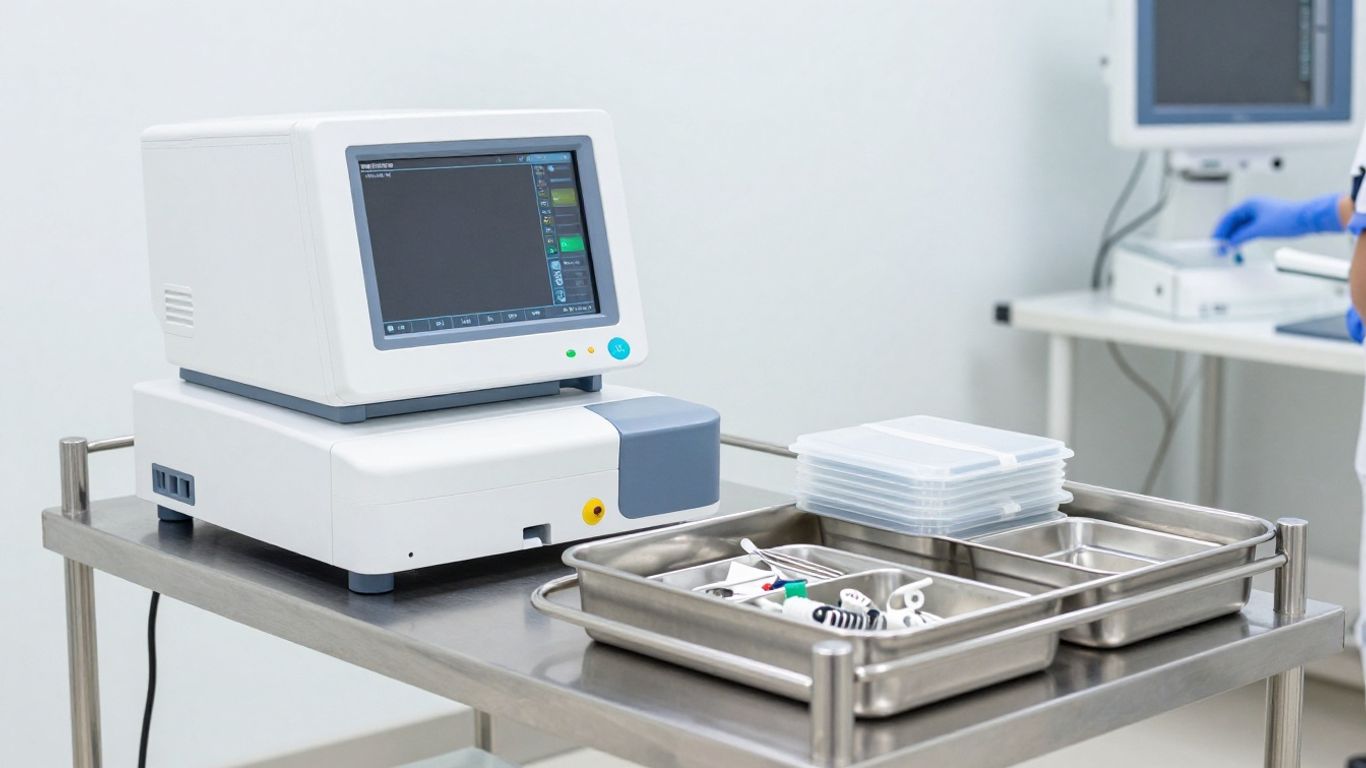 When you compare options, involve the users who understand the work and the technical staff who understand the infrastructure. The best choice is usually the one that fits the whole service, including accessories, data flow, cleaning, maintenance, and replacement availability.
Diagnostic and patient-monitoring equipment
For diagnostic and monitoring equipment, assess the intended clinical application, measurable performance, patient interfaces, alarms, data export, and compatibility with existing systems. Ask how the equipment behaves during network interruptions or power events, and identify what must be checked during calibration or preventive maintenance.
Do not compare a feature list without considering workload. A unit that fits a small clinic may not support the throughput, integration, or redundancy required by a hospital department. Request demonstrations using representative workflows when the purchase has a significant clinical or operational impact.
Laboratory and sterilization equipment
Laboratory and sterilization equipment should be assessed for capacity, cycle or test requirements, environmental conditions, validation, consumables, and operator workload. Confirm what utilities are needed and whether the room can support them without affecting other equipment. For instruments that influence clinical decisions, clarify quality-control procedures, maintenance intervals, and documentation responsibilities.
Ask about reagent, accessory, and spare-part continuity before choosing a platform. A technically capable instrument can still create delays if its required supplies are difficult to obtain or if service depends on a single unavailable component.
Surgical, emergency, and critical-care equipment
Surgical, emergency, and critical-care equipment demands close attention to reliability, ergonomics, alarm behavior, battery or backup arrangements, cleaning, and rapid access to support. Review how staff will use the equipment under pressure and whether the proposed configuration supports safe movement, visibility, and infection-control procedures.
For these categories, implementation planning should begin during selection. Confirm the availability of essential accessories and identify backup arrangements for periods of maintenance. A supplier’s ability to coordinate installation and commissioning can be as important as the equipment specification itself.
Consumables, accessories, and replacement parts
Consumables and accessories often determine whether a major device remains usable. Record the exact compatible items, packaging, shelf life, storage conditions, ordering units, and expected usage. Ask whether alternative components are approved and what process controls a substitution.
Use a simple comparison table when reviewing the full supply picture. It keeps recurring costs and operational dependencies visible rather than allowing the capital price to dominate the decision.
Comparison area Questions to ask Why it matters Compatibility Which accessories, software, and consumables are approved? Prevents unusable or unsafe substitutions. Supply continuity What are the normal lead times and reorder points? Reduces interruptions to clinical work. Maintenance Which parts require scheduled replacement? Makes recurring service costs predictable. Storage and handling What conditions, expiry controls, or inventory records apply? Protects product quality and availability. After completing the table, add the recurring items to your procurement forecast and asset records. This gives you a more realistic view of the equipment’s operating demands before you approve the purchase.
Plan delivery, installation, and implementation
A successful order can still fail operationally if delivery and implementation are treated as someone else’s responsibility. Assign an owner from your organization and create a schedule that connects customs, site readiness, installation, training, testing, and go-live. Put assumptions in writing so a missed dependency does not become a last-minute delay.
New Star Company WLL states that it provides installation and commissioning alongside product and technical support. Whether you work with this or another supplier, request a project plan that names the activities, responsible parties, required inputs, and completion evidence for each stage.
Confirm shipping, customs, and delivery responsibilities
Your purchase agreement should state the delivery point, shipping terms, insurance responsibility, customs documentation, unloading method, storage conditions, and treatment of damaged or delayed goods. Confirm whether the supplier will coordinate import clearance and what information your organization must provide.
For temperature-sensitive, fragile, or high-value equipment, define monitoring and inspection at arrival. Record packaging condition, serial numbers, accessories, and any visible damage before the shipment is moved or unpacked.
Coordinate site preparation and equipment installation
Site preparation may include electrical circuits, grounding, network points, medical gases, ventilation, drainage, structural support, room clearance, and infection-control arrangements. Obtain the supplier’s installation drawings and utility requirements early, then have your facilities and engineering teams approve the completed work.
Schedule installation around clinical operations, construction access, and delivery conditions. If several systems must work together, identify the sequence and the person responsible for coordinating the interfaces. This is where a comprehensive distributor can add practical value, provided its scope is explicit.
Arrange user training and operational handover
Training should be matched to each user group. Operators need safe workflows, routine checks, cleaning, alarms, and basic troubleshooting; technical staff may need maintenance, diagnostics, and escalation procedures. Keep attendance records and define how new staff will be trained after the initial handover.
The handover should include manuals, quick-reference materials, certificates, service contacts, warranty information, asset data, and a list of open actions. Do not treat training as complete until users can perform the agreed workflow and know how to obtain help.
Prepare acceptance testing and commissioning procedures
Write the commissioning procedure before installation begins. It should specify the tests, equipment or reference materials required, pass criteria, documentation, responsible signatories, and the process for correcting failures. Where a device connects to a network or another system, include interface and data-flow checks.
A practical implementation sequence usually includes the following steps:
- Inspect the shipment and verify the model, serial number, accessories, and condition.
- Complete site and utility checks before energizing or connecting the equipment.
- Perform installation, safety checks, calibration, configuration, and required connectivity tests.
- Train users and technical staff, then record attendance and outstanding questions.
- Complete acceptance testing, sign the handover, and assign unresolved actions with dates.
After these steps, keep the commissioning record with the asset file and schedule the first service or review date. A signed delivery note alone does not prove that the equipment is ready for clinical use.
Measure long-term value and after-sales support
The purchase decision continues after acceptance. You need evidence that the equipment will remain available, maintainable, and appropriate as clinical demand changes. Establish service expectations at the start so a future repair does not become a negotiation conducted under pressure.
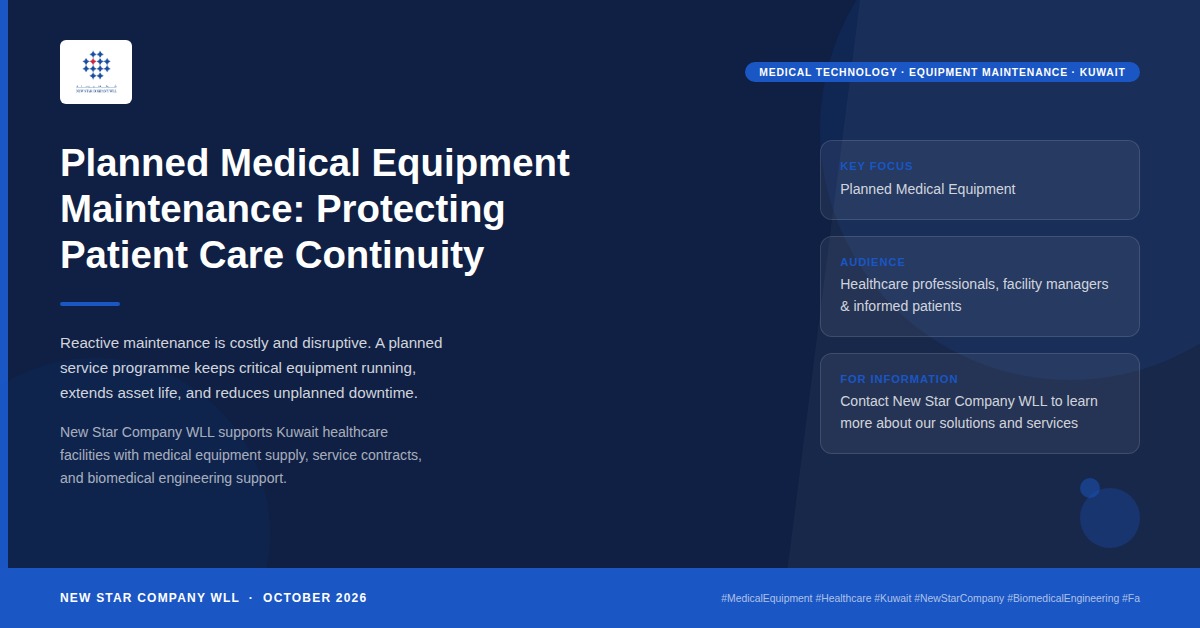
A supplier’s after-sales model should be visible in the contract, service documentation, escalation route, and performance reviews. New Star Company WLL describes after-sales service and long-term customer support as part of its offering; evaluate those commitments through response targets, named contacts, maintenance plans, and completed service records.
Compare total cost of ownership beyond the purchase price
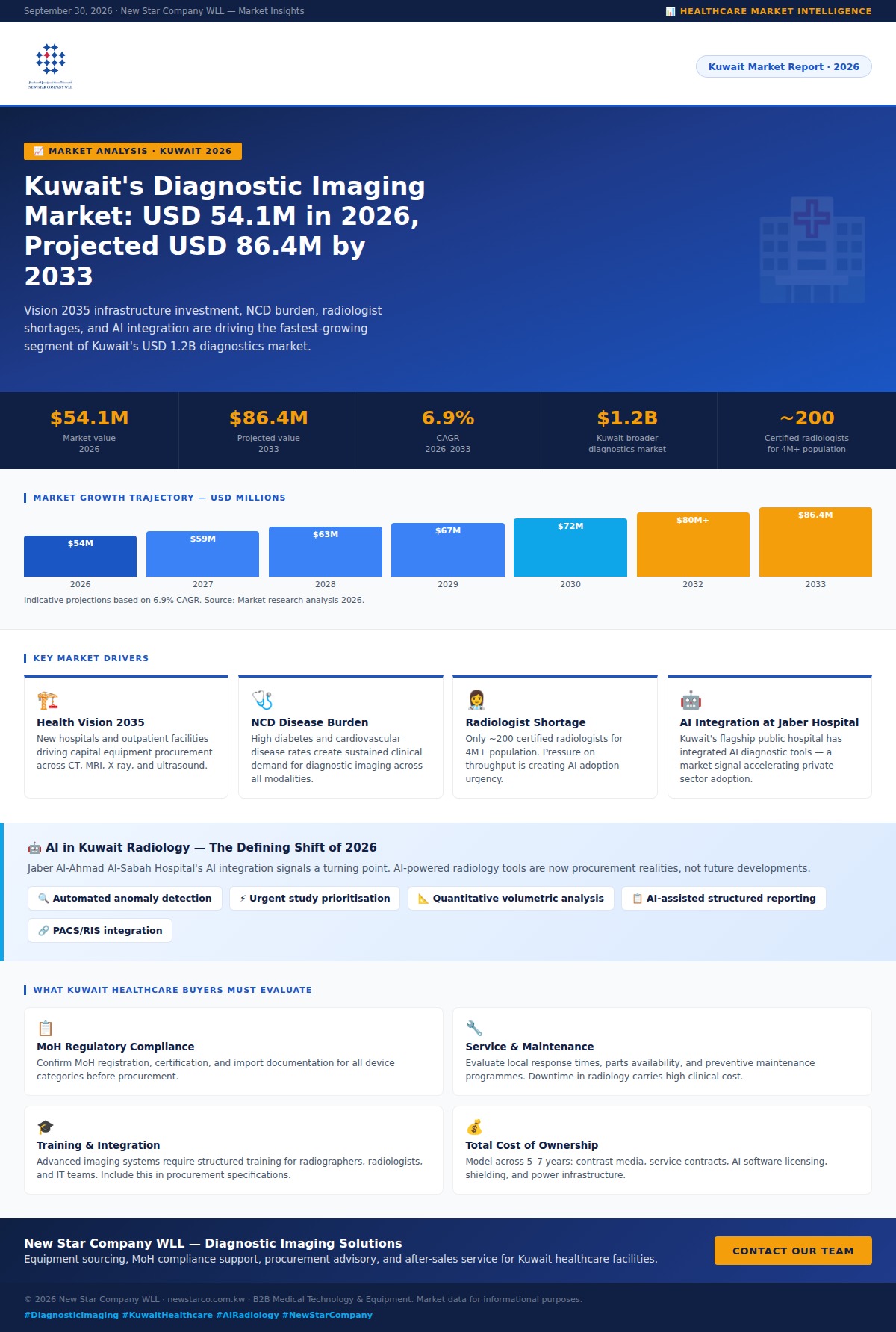
Calculate more than the initial invoice. Include freight, installation, training, utilities, software or connectivity, consumables, preventive maintenance, calibration, repairs, downtime, and eventual disposal or replacement. If the equipment requires proprietary supplies, model likely usage over the expected life rather than relying on the first order price.
A total-cost comparison does not always favor the lowest capital quote. It helps you see whether a higher initial investment could reduce recurring costs or operational disruption, while also revealing when an apparently affordable option carries expensive dependencies.
Evaluate preventive maintenance and repair response times
Ask for the preventive-maintenance schedule, service levels, response times, escalation process, and reporting format. Clarify whether support is remote, on-site, or provided through a manufacturer; also confirm coverage outside standard working hours when the equipment supports urgent care.
Track actual performance after installation. Useful measures include response time, time to restore service, repeat failures, preventive-maintenance completion, and the number of days equipment is unavailable. Use those records in renewal and replacement discussions rather than relying on memory.
Confirm spare-parts availability and service coverage
Confirm which spare parts are held locally, how parts are ordered, expected delivery times, and whether obsolete components have an approved replacement. Ask how service coverage changes if the manufacturer discontinues a model or a local engineer is unavailable.
For equipment spread across multiple sites, define whether the supplier can support each location and how travel, parts, and emergency visits are charged. Written coverage is particularly important when a facility depends on a small number of critical units.
Establish performance reviews and equipment replacement plans
Hold periodic reviews with clinical users, biomedical engineering, procurement, finance, and the supplier. Discuss utilization, downtime, service costs, user feedback, safety notices, consumable availability, and whether the equipment still meets the department’s needs. The review should produce actions, owners, and dates rather than becoming a general status meeting.
Maintain a replacement plan that reflects condition, risk, utilization, supportability, and available funding. When you keep this plan current, you can procure methodically and avoid extending an unsuitable asset simply because its replacement was not anticipated.
Conclusion
A trusted medical equipment supplier in Kuwait should help you move from a defined clinical requirement to compliant procurement, safe installation, confident use, and dependable support. By testing specifications, documentation, service capability, total cost, and implementation responsibilities, you give your healthcare organization a stronger basis for every purchase.
Frequently Asked Questions
What should you check first when choosing a medical equipment supplier in Kuwait?
Start with your clinical requirements, facility conditions, budget, delivery timeline, and service expectations. Then verify the supplier’s regulatory documentation, manufacturer relationships, technical capability, references, and after-sales process.
How can you compare medical equipment quotations fairly?
Normalize each quotation by comparing the same model and configuration, accessories, installation, training, warranty, consumables, delivery terms, taxes, lead time, and exclusions. A lower headline price may omit costs that another supplier has included.
Why do installation and commissioning matter?
Equipment may require specific utilities, configuration, connectivity, calibration, safety checks, and user training before it is ready for clinical use. Commissioning documents those checks and provides evidence that the agreed acceptance criteria were met.
What documents should a healthcare organization request?
Depending on the equipment, request regulatory and import documents, manufacturer certifications, manuals, declarations, warranty terms, serial-number records, installation requirements, maintenance schedules, and acceptance or commissioning records.
How should you assess after-sales support?
Ask for preventive-maintenance plans, response times, escalation contacts, spare-parts arrangements, service coverage by location, and sample service reports. References from organizations with similar equipment can help you test whether the written commitments are practical.
What is total cost of ownership for medical equipment?
Total cost of ownership includes the purchase price and the costs of delivery, installation, training, utilities, consumables, maintenance, repairs, downtime, upgrades, and eventual replacement or disposal over the equipment’s useful life.
When should you plan to replace medical equipment?
Begin planning before the equipment reaches the end of its useful life. Review age, condition, utilization, downtime, repair costs, supportability, safety notices, compatibility, and clinical requirements so replacement funding can be arranged without disrupting care.