
Key Takeaways
Finding dental materials near me is less about choosing the closest seller and more about confirming quality, availability, compatibility, and support. A clear purchasing process helps you protect clinical standards while keeping routine work moving.
- Define materials by procedure, equipment, and infection-control needs.
- Compare product range, pricing, delivery, pickup, and supplier support.
- Check documentation, shelf life, storage, authenticity, and returns.
- Use local pickup for urgent needs and online catalogs for planned orders.
- Track stock and supplier performance so reordering becomes predictable.
Define the dental materials your practice needs
Before you search for dental materials near me, map what your practice actually uses. A general list may overlook items needed for a particular procedure, while an oversized order can tie up cash and create expiry problems. Start with treatment types, procedure frequency, equipment compatibility, and infection-control requirements. Then separate regular consumables from durable instruments, equipment, and specialty materials.
Consumable supplies for daily procedures
Daily consumables are the products that leave your storeroom quickly: gloves, masks, barriers, suction products, cotton products, anesthetic supplies, burs, mixing accessories, and disposable instruments. Your list should reflect the procedures performed by each operatory rather than simply copying a general catalog category. Record the preferred size, material, packaging, and acceptable alternatives for each item.
A useful review also distinguishes between essential stock and convenience stock. Essential items need a reliable minimum quantity because a shortage can delay treatment. Convenience items can often be purchased less frequently or substituted after clinical review. This distinction gives you a practical basis for comparing a local supplier with a larger online catalog.
Restorative, impression, and laboratory materials
Restorative and impression products require closer attention to technique and compatibility. Include materials such as cements, liners, bonding products, composites, impression materials, bite-registration products, gypsum, waxes, and laboratory accessories where they match your clinical services. For each product, note the intended use, mixing or curing method, working time, setting time, and storage conditions.
If your practice sends work to a laboratory, purchasing decisions should also include the laboratory’s accepted materials and specifications. A material that seems economical may create extra handling, remakes, or communication if it does not fit the laboratory workflow. Ask suppliers for current instructions for use and technical data before you standardize a product.
Equipment, instruments, and infection control products
Equipment and reusable instruments deserve a different purchasing approach from disposable supplies. Consider hand instruments, handpieces, sterilization equipment, ultrasonic devices, compressors, suction systems, storage units, and maintenance requirements. Infection-control products should be assessed alongside the equipment they support, including sterilization pouches, indicators, disinfectants, surface barriers, and personal protective equipment.
Your supplier review should cover more than the initial price. Installation, commissioning, preventive maintenance, repair response, and access to replacement parts can affect the equipment’s practical value. New Star Company WLL is positioned as a Kuwait-based distributor serving healthcare organizations with technical expertise, installation, commissioning, after-sales service, and long-term customer support, which are useful considerations when you evaluate equipment suppliers.
Specialty materials for orthodontics, implants, and endodontics
Specialty procedures create narrower material requirements and less room for substitution. Orthodontic practices may need brackets, wires, elastomerics, adhesives, separators, and finishing accessories. Implant and surgical workflows may require grafting or restorative materials, sterile products, surgical instruments, and traceable components. Endodontic procedures can involve files, irrigation products, obturation materials, sealers, and isolation accessories.
List these items separately and identify which products require clinician approval before replacement. For specialty materials, a supplier’s familiarity with technical documentation and ordering details can matter as much as geographic proximity. New Star Company WLL’s broader healthcare distribution and technical-support positioning may be relevant when a practice is assessing a supplier for more than routine consumables.
Compare local dental suppliers
Once your requirements are clear, compare suppliers using the same criteria. Search results can make one source look attractive because of price, while another may be stronger in service, product documentation, or urgent availability. A fair comparison considers the complete purchasing experience from quotation through delivery and follow-up support.
 You can also review broader catalogs, such as dental supply categories, when you want to check whether a supplier covers consumables, infection control, instruments, equipment, and specialty products. Use catalog breadth as a starting point, then confirm that the exact products you need are currently available and suitable for your practice.
Product selection and brand availability
A supplier may list many categories but still lack the brands, sizes, or formulations your clinicians prefer. Ask whether the listed product is in stock, routinely imported, or available only by special order. Confirm replacement options carefully; a different brand may have different handling characteristics, indications, or equipment requirements.
It is useful to maintain a short approved list rather than asking staff to choose from an unlimited catalog. Include the product name, manufacturer, size, pack quantity, approved substitute, and person responsible for clinical approval. This makes a conversation with a local supplier more precise and reduces accidental substitutions.
Pricing, bulk discounts, and account terms
Compare the landed cost rather than the displayed unit price. Include pack size, delivery fees, taxes or applicable charges, minimum order values, and the cost of holding excess stock. A bulk discount is only helpful if your practice can use the quantity before expiry and store it correctly.
Ask about account terms, quotation validity, payment arrangements, and the process for correcting an invoice or short shipment. If you manage several clinics or departments, request pricing in a format that allows like-for-like comparison. The lowest quotation may not be the lowest total cost once delays, returns, and staff time are included.
Delivery speed, pickup options, and service areas
Delivery promises should be specific enough to support planning. Ask whether the stated time is the order-processing time, the transit time, or the complete time from confirmation to receipt. For urgent materials, confirm whether local pickup is genuinely available and whether the product is physically held at the pickup location.
Service-area coverage matters in Kuwait when deliveries move between clinics, central stores, and laboratories. Give the supplier accurate delivery details and identify a contact who can receive temperature-sensitive, fragile, or high-value items. A supplier that can coordinate product delivery with technical support may be more useful for equipment than a seller offering delivery alone.
Supplier reputation and customer support
Reputation is best assessed through consistent evidence rather than a single review. Look for clear contact channels, knowledgeable responses, transparent invoices, and a defined process for damaged, incorrect, or delayed orders. You can also ask whether the supplier provides product guidance, technical assistance, installation, or after-sales service for the categories you purchase.
New Star Company WLL describes a service model that combines internationally recognized manufacturers with local technical expertise, installation, commissioning, after-sales service, and long-term support. When those services match your needs, assess them directly during the quotation process: ask who will support the product, what is included, and how service requests are handled.
Evaluate dental material quality and safety
Price and proximity cannot replace quality controls. Dental materials enter clinical workflows where incorrect storage, poor traceability, or unclear instructions can affect staff and patients. Before adding a product to your approved list, review the documentation and confirm that the supplier can identify what you received.
Quality evaluation should be practical. You do not need an elaborate scoring system for every low-risk disposable, but you should apply greater scrutiny to materials with direct clinical, surgical, sterilization, or equipment implications. Record the decision so future buyers know why a product was approved.
Regulatory compliance and product documentation
Ask for the documentation appropriate to the product and its intended use. Depending on the item, this may include labeling, instructions for use, safety data, conformity information, sterilization instructions, lot details, and manufacturer information. Check that documents correspond to the exact product and version rather than a similar item in the same range.
Your clinical and quality leads should review any material that affects treatment technique or patient safety. Keep the accepted documentation accessible to the staff who use the product. If a supplier cannot answer basic questions about intended use, storage, or traceability, pause the purchase until the information is clarified.
Shelf life, storage requirements, and batch tracking
Shelf life is especially important when products are ordered in bulk. Check the expiry date at receipt and confirm that the remaining usable period fits your expected consumption. Some materials also require protection from heat, light, moisture, or temperature variation, so storage instructions should be shared with everyone handling stock.
Batch tracking supports investigation and recall management. Record the lot or batch number for materials where traceability is clinically relevant, and retain invoices or delivery records that connect the batch to a supplier. A simple receiving check can identify damaged packaging, missing labels, or an unsuitable expiry before the product reaches an operatory.
Manufacturer warranties and return policies
For equipment and reusable instruments, read the warranty scope before purchase. Clarify what is covered, how service is requested, whether labor or transport is included, and which actions could void coverage. For consumables, ask how the supplier handles incorrect items, damaged packaging, suspected defects, and products that arrive too close to expiry.
Return policies should be written clearly enough for a staff member to follow. Some products cannot be returned after opening, while others may require notification within a set period. Keep the original packaging and delivery record until the receiving team has completed its check.
Authenticity and authorized distribution
Authenticity is not something you should assume from a professional-looking website. Check the manufacturer name, packaging, lot information, importer or distributor details, and consistency between the product received and the product ordered. Be cautious when a price is unusually low or when packaging appears altered, incomplete, or different from the approved sample.
Where possible, ask whether the supplier is authorized to distribute the product in your market. This can help clarify warranty support, documentation, and the proper route for product complaints. A reliable supplier should be comfortable explaining the source and support pathway without making vague assurances.
Choose between local stores and online suppliers
The right channel depends on urgency, product complexity, and how predictable your demand is. Local stores can be useful when a procedure cannot wait, while online catalogs can simplify planned purchasing and comparison. Many practices use both rather than treating the choice as permanent.
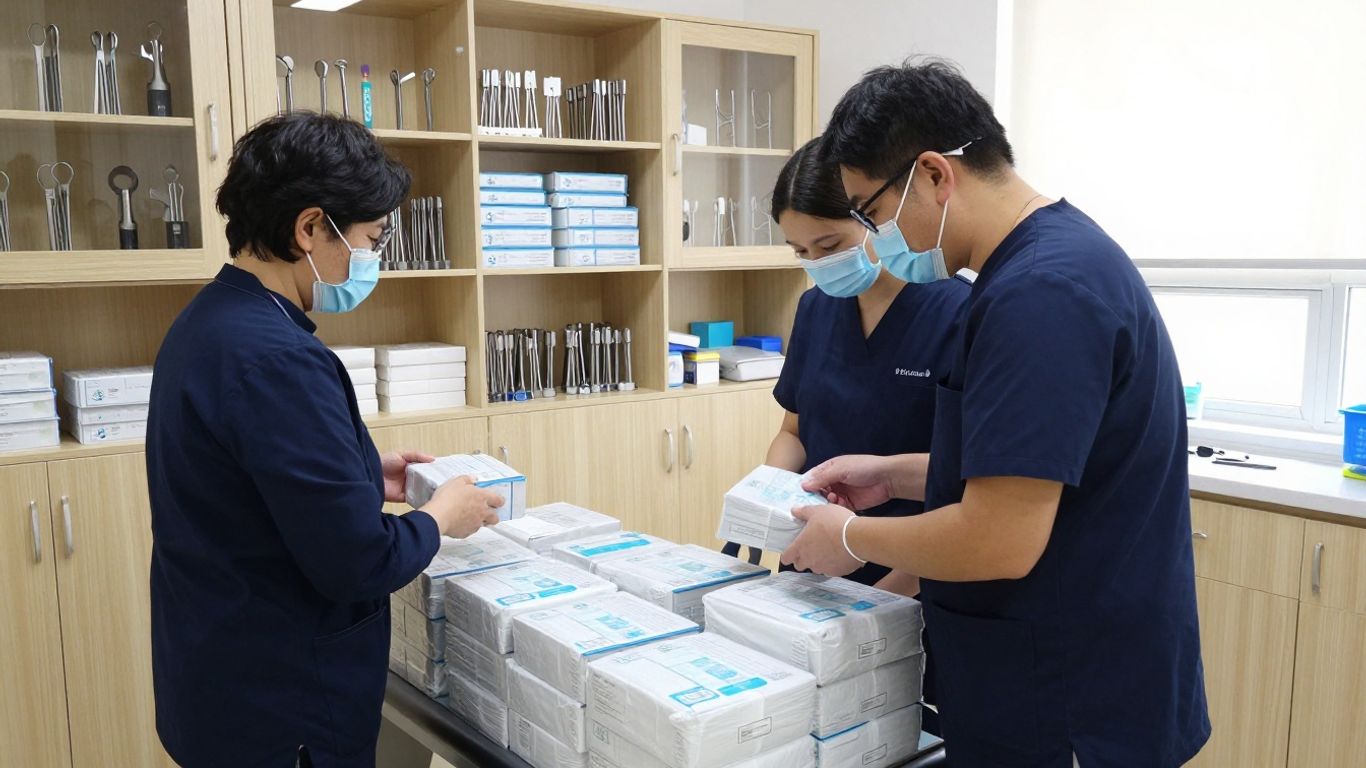 If you are comparing online options, review online dental ordering as one example of the catalog model, then verify the actual shipping, guarantee, payment, and support terms before relying on any supplier. The channel should fit your controls, not force your team into unfamiliar purchasing habits.
When same-day local pickup is valuable
Same-day pickup has clear value when a critical consumable runs out before the next scheduled delivery. It can also help when a clinician needs to inspect an unfamiliar product, when a replacement is required for a failed accessory, or when a patient appointment would otherwise be postponed. The benefit is greatest when the supplier confirms live stock rather than simply displaying an item online.
Build a small emergency plan around local availability. Identify which products justify same-day sourcing and which can wait for the normal order cycle. This prevents staff from paying a premium for urgent delivery when a modest safety stock would have solved the problem.
Advantages of ordering from an online catalog
An online catalog can make recurring purchasing easier by displaying product specifications, pack sizes, and order history in one place. It may help you compare alternatives outside normal business hours and reorder familiar items without repeating every detail. For a multi-clinic practice, a shared catalog can also support more consistent product selection.
The convenience is strongest when catalog information is current. Check whether stock status is updated in real time, whether substitutions require approval, and whether the invoice reflects the price shown at checkout. A polished interface does not by itself confirm product quality or delivery reliability.
Shipping costs, minimum orders, and backorder risks
Shipping can change the economics of an online order, especially for low-value or bulky items. Calculate delivery charges against the quantity you actually need, and check whether free-shipping thresholds encourage over-ordering. Minimum orders should be compared with your consumption rate and storage capacity.
Backorders deserve explicit attention because a missing item can affect a whole procedure set. Before submitting an order, identify any products with uncertain availability and decide whether an approved alternative exists. Do not accept an unreviewed substitute simply because the original item is delayed.
How to verify a remote supplier before purchasing
A remote supplier should provide enough information for you to identify the business, contact support, review policies, and confirm product details. Check the legal or business information available on the site, the physical contact details, the returns process, and the way complaints are handled. For higher-risk products, request documentation before placing a large order.
Use a small, low-risk order to test fulfillment if you have not worked with the supplier before. Confirm that the delivered product matches the order, the packaging is intact, and the invoice is accurate. That first transaction can reveal more about reliability than a broad product claim.
Match materials to clinical and operational requirements
A product can be genuine and well priced yet still be a poor fit for your practice. Your clinicians, assistants, sterilization team, and purchasing staff each interact with materials differently. A sound decision considers the entire workflow, from preparation and use to cleanup, documentation, and replenishment.
The goal is not to make every procedure identical. It is to reduce avoidable variation where standardization improves safety, training, and stock control, while preserving clinical judgment where different techniques are appropriate.
Compatibility with existing equipment and workflows
Check physical, chemical, electrical, and software compatibility before introducing a product. A material may require a particular dispenser, curing light, mixing unit, handpiece, sterilization cycle, or storage arrangement. Equipment purchases should also account for available utilities, room layout, installation requirements, and service access.
Ask the supplier for compatibility information in writing when a product will be connected to existing equipment. A short pre-purchase review can prevent an expensive mismatch. New Star Company WLL’s stated involvement in installation and commissioning is relevant to organizations that need support beyond delivery, but you should still confirm the exact scope for the product under consideration.
Performance, handling, and ease of use
Performance should be assessed in the conditions where the product will actually be used. Consider working time, viscosity, setting behavior, curing requirements, instrument feel, packaging, and cleanup. A product that performs well in a demonstration may still be inconvenient if it adds steps or requires unfamiliar handling.
Where appropriate, run a controlled trial with the clinicians and assistants who will use the material. Gather feedback on preparation, application, consistency, and waste. Keep the trial separate from a general impression of the brand; the decision should relate to the product and procedure being evaluated.
Patient safety and treatment outcomes
Patient safety remains the central filter for every purchasing decision. Review intended use, contraindications, handling precautions, storage, and the consequences of using an alternative product. Do not allow an attractive price or urgent availability to bypass clinical approval.
Treatment outcomes also depend on technique, preparation, isolation, equipment condition, and follow-up. A supplier cannot replace clinical judgment or staff competence. What a dependable supplier can do is help you obtain documented products consistently and respond when questions or product issues arise.
Staff training and standardization across procedures
When several staff members use the same material, standardization can reduce errors and shorten onboarding. Create a short procedure guide covering preparation, application, curing or setting, cleanup, disposal, and storage. Include photos or manufacturer instructions where they genuinely clarify a step.
Training should be refreshed when a product, package, equipment setup, or clinical protocol changes. Ask staff to report handling problems and near misses rather than quietly improvising. Their feedback can show whether a product is technically suitable but operationally awkward.
Build a dependable dental supply purchasing process
Reliable sourcing comes from repeatable habits rather than one successful order. Assign responsibility for clinical approval, purchasing, receiving, storage, and supplier review. Make the process simple enough that it will be followed during a busy clinic day.
A good system also creates a record of why products were selected. That record supports continuity when a purchasing employee leaves, a supplier changes stock, or a new clinic joins the organization. It gives you a clear basis for discussing quality and cost with suppliers.
Create an approved product and supplier list
Your approved list should identify the product, manufacturer, size, approved use, storage requirement, substitute status, and supplier. Separate clinically approved alternatives from products that are merely available. Set a review date for high-use and high-risk items, especially when manufacturers change packaging or instructions.
Supplier records can include contact details, service categories, delivery terms, warranty information, escalation contacts, and performance notes. This makes it easier to route a routine order, an equipment issue, or a product complaint to the right person.
Track inventory and set reorder points
Inventory tracking does not have to be complex. Start with usage history, lead time, minimum stock, expiry risk, and the number of locations drawing from the supply. Count high-use and high-risk items more frequently than slow-moving products.
A simple reorder review can cover these practical checks:
- Current quantity compared with the approved minimum.
- Open orders and their confirmed delivery dates.
- Expiry dates and storage conditions.
- Upcoming procedures or seasonal demand changes.
After this review, reorder points become more than arbitrary numbers. They reflect how quickly your practice uses an item and how long the supplier normally takes to deliver it. Adjust them when procedure volume, delivery performance, or clinic locations change.
Consolidate orders without compromising availability
Combining orders can reduce administrative work and delivery charges, but consolidation should not create a shortage risk. Group stable, frequently used items when demand and shelf life support it. Keep urgent, temperature-sensitive, fragile, or unpredictable items on a separate purchasing path when necessary.
Set an ordering calendar while preserving an exception route for clinical emergencies. Staff should know who can approve an unplanned purchase and what information must be recorded. That balance gives you purchasing discipline without making the system too rigid for patient care.
Review supplier performance and total costs regularly
Review suppliers using evidence from the previous period. Track on-time delivery, order accuracy, backorders, damaged goods, response time, warranty handling, and the frequency of approved substitutions. Also review how much staff time is spent correcting orders or following up on missing information.
The most useful comparison is total cost over time, not a single invoice. A supplier that supports documentation, installation, technical questions, and after-sales service may reduce operational friction, but you should measure that value against your actual experience. Reassess the approved list when service quality changes, a product is discontinued, or your clinical requirements develop.